Flood Cleanup & Water Extraction Companies in Southwest Florida
Flood Cleanup & Water Extraction is one of the most time-sensitive home services in Southwest Florida, where humidity, hurricane season and aging plumbing drive constant demand. The 1 verified flood cleanup & water extraction companies in this directory serve Fort Myers, Cape Coral, Naples and the surrounding metro.
A professional flood cleanup & water extraction company handles assessment, mitigation, drying or cleanup, and full restoration — and coordinates directly with your insurance carrier. Acting fast is what keeps a small loss from becoming a major structural or mold problem.
Every company below is rated by real customers (averaging 4.8★), offers emergency response, and serves a defined area. Browse flood cleanup & water extraction by city, or call a provider directly.
Flood Cleanup & Water Extraction by city
Top providers
Zip Flood Control, Pool Cages Hurricane Windows & Shutters LLC
16121 Pine Ridge Rd #3, Fort Myers, FL 33908, Cape Coral, Florida 33908
What Are the Different Categories of Water Damage and What Do They Mean?
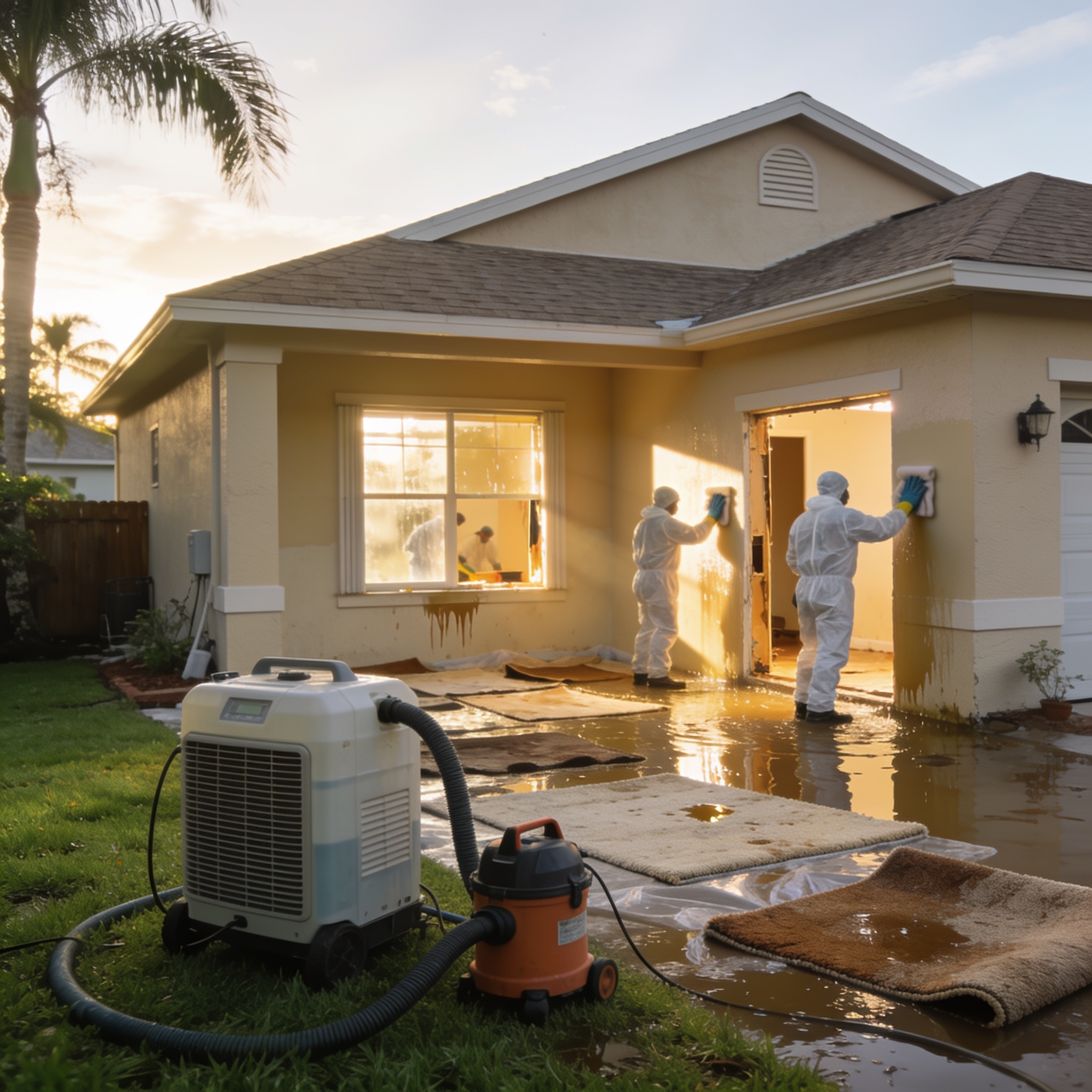
The IICRC S500 standard defines three categories of water damage that determine how crews respond, what protective gear they wear, and how aggressively they must dry and disinfect affected areas. Understanding the water category assigned to your loss is the first step any professional water damage restoration team takes on arrival. Category 1 is clean water from a supply line break, burst pipe, or failed water heater — the least hazardous starting point. Category 2, often called “gray water,” carries contaminants from appliance overflows or roof leaks. Category 3, or “black water,” includes sewage backups and floodwater that has contacted the ground — the type of water most common after the major flooding events that strike Fort Myers, Cape Coral, and Naples during hurricane season.
Categories can escalate quickly in SW Florida’s humid climate. IICRC guidance notes that stagnant water left longer than 24 to 48 hours can promote mold growth and push a Category 1 loss into Category 2 or 3 territory. That escalation creates damage and mold conditions that pose serious health risks and significantly increase restoration costs, which is why the priority to remove standing water rapidly is critical every time there is a water loss.
Why Category Matters for Lee, Collier, and Charlotte County Homeowners
Much of Cape Coral sits in FEMA Flood Zone AE, and large portions of Fort Myers and Naples carry similar designations, meaning ground water intrusion during storms is a documented, recurring hazard for florida communities across the region. When flood damage brings water into a home, it is automatically treated as Category 3 regardless of how clean it looks, because it has contacted soil and potential contaminants. Every technician on a damage restoration company crew must follow strict decontamination protocols before structural drying can begin.
What Services Are Included in Emergency Flood Cleanup and Water Extraction?
A full water damage response in Southwest Florida typically includes water extraction, moisture mapping, structural drying, dehumidification, content manipulation, and documentation for insurance claims — all delivered under one coordinated project. Engaging reputable flood cleanup services means crews deploy submersible pumps and truck-mounted extraction equipment to remove water fast, then transition to air movers and LGR dehumidifiers to pull residual moisture from building materials. Sewage cleanup, pack-out of salvageable contents, and antimicrobial treatment of affected areas are also standard components when flooding is involved.
Commercial properties in Fort Myers and Naples often require additional services such as desiccant drying systems for large floor plates and after-hours scheduling to minimize business interruption. Residential water damage restoration and repair in Cape Coral and Lehigh Acres commonly involves drywall removal to expose wall cavities where hidden water accumulates and mold growth can begin unseen.
What Is the Difference Between Water Mitigation and Water Remediation?
Water mitigation focuses on stopping the water loss from getting worse — water removal, drying the structure, and protecting undamaged property — while remediation addresses contamination and biological hazards that flooding has already introduced. Think of mitigation as the emergency phase and remediation as the treatment phase. Both are necessary after the floods of SW Florida, but they require different equipment, certifications, and sometimes different licensed contractors.
Mold remediation, for example, is a separate scope governed by Florida’s Mold-Related Services Act (Chapter 468, Part XVI, Florida Statutes), which requires a licensed mold assessor and a licensed mold remediator to operate independently. A water cleanup company may offer both services under one roof, but the assessment and the remediation work must remain separate functions under Florida law.
What Is the Process for Water Damage Restoration, From Extraction to Repair?
Water damage restoration follows a defined sequence: emergency response and safety assessment, water extraction, moisture mapping, structural drying, cleaning and remediation, and finally reconstruction to pre-loss condition. Each phase feeds the next, and skipping steps — especially moisture mapping — is the most common reason mold problems surface weeks after a flood cleanup appears complete. Storm damage in particular often affects multiple building systems simultaneously, making a thorough step-by-step process essential.
Step 1 — Extract and Assess
Crews use extraction equipment including truck-mounted vacuums and submersible pumps to locate water and remove it from floors and crawl spaces. Technicians deploy thermal imaging to ensure hidden water inside walls, ceilings, and subfloors is fully identified and mapped before any drying equipment is placed — ensuring no affected area is overlooked before the structural drying phase begins.
Step 2 — Structural Drying and Dehumidification
Industrial air movers create high-velocity airflow across wet surfaces while LGR dehumidifiers capture the moisture-laden air and exhaust dry air back into the space. Technicians monitor moisture levels daily using moisture meters and adjust equipment placement based on moisture mapping data. IICRC S500 guidelines recommend drying to pre-loss moisture levels, typically between 10–17% for wood framing in FL conditions.
Step 3 — Cleaning, Remediation, and Rebuild
Once affected areas reach drying goals, crews remove compromised drywall, treat framing with antimicrobials, and coordinate reconstruction. In Naples, Fort Myers, and across Southwest Florida, many restoration and repair companies work directly with licensed general contractors to carry the project from water extraction all the way through finished repairs.
What Should I Do Before a Water Damage Restoration Team Arrives?
The most important actions before a crew arrives are to stop the water source if safely possible, cut power to flooded rooms, and document everything with photos and video for your insurance claim. Water damage such as burst pipes or supply line failures requires locating the main shutoff and closing it immediately. Do not enter rooms with standing water if electrical panels or outlets may be submerged — electrocution is a documented risk in flood events across Lee and Collier counties.
Move undamaged valuables and electronics to dry areas of the home, but avoid using household fans or HVAC systems to try to dry the space yourself. Circulating air through contaminated flood water can spread bacteria and accelerate secondary mold growth in wall cavities before a technician has a chance to assess hidden moisture behind walls and under flooring. Leave drying equipment decisions to the professionals.
How Quickly Can Emergency Water Cleanup Services Respond in Southwest Florida?
Most verified providers listed in this directory offer 24/7 emergency response with on-site arrival targets of 60 to 90 minutes for Fort Myers, Cape Coral, Naples, and Bonita Springs under normal road conditions. Response times can extend during and immediately after major storm events — Hurricane Ian in September 2022 generated thousands of simultaneous water damage such as burst pipes, roof failures, and storm surge intrusion calls across Lee and Charlotte counties, overwhelming regional capacity for several days. Having a provider’s number saved before a storm is the single most effective way to secure early placement in the dispatch queue.
FEMA guidance emphasizes that a water leak or intrusion left unaddressed for more than 24 to 48 hours dramatically increases secondary damage risk, including mold growth and structural deterioration. Emergency water cleanup teams prioritize extract-and-dry speed precisely because the humid subtropical climate of SW Florida accelerates every biological and structural risk associated with flooding.
Can Hardwood Floors Be Saved After a Water Event?
Hardwood floors can often be saved if water extraction and structural drying begin within 24 to 48 hours of the flooding event, before the wood has cupped, buckled, or developed secondary mold growth beneath the surface. Technicians use moisture meters and moisture detection tools to measure moisture levels in the floor assembly, including the subfloor below. If readings are caught early, targeted air movers placed at floor level combined with aggressive dehumidification can draw moisture from wet materials without requiring full floor replacement.
In Naples FL and Fort Myers, where many homes feature engineered hardwood or solid wood floors over concrete slabs, the slab itself retains moisture long after the surface appears dry. Thermal imaging is used to locate water and hidden moisture trapped at the slab-floor interface — a critical step that prevents the floor from re-wetting from below after the crew leaves. Floors that have been submerged in Category 3 floodwater typically must be removed due to contamination, regardless of their structural condition.
Do Water Damage Restoration Companies Also Handle Mold Prevention and Remediation?
Many water damage restoration companies in Southwest Florida offer integrated mold prevention services as part of their drying scope, and some hold separate Florida mold remediation licenses to handle full water damage remediation when growth is confirmed. Antimicrobial treatments applied to affected areas during the drying phase are a standard preventive measure — they are not a substitute for licensed mold remediation if visible mold or elevated spore counts are found. Property owners should ask providers directly whether their mold services are performed under a separate Florida-licensed mold remediator.
Given that damage and mold can begin developing on damp building materials within 24 to 48 hours in FL’s humidity, the connection between flood damage cleanup and mold remediation is inseparable in this region. Moisture mapping performed during structural drying is the primary tool for identifying hidden moisture pockets in drywall and framing before they become active mold growth sites. Crews serving Myers, Cape Coral, and the broader Lee County area routinely find mold behind baseboards and inside wall cavities that show no visible signs of water damage from the room side.
Will My Insurance Cover the Cost of Emergency Water Cleanup and Restoration?
Standard homeowners insurance policies in Florida typically cover sudden and accidental water damage — such as damage from water damage such as burst pipes, supply line failure, or roof leak — but do not cover flooding from storm surge or rising groundwater unless the property owner carries a separate NFIP or private flood insurance policy. This distinction is critical across Lee, Collier, and Charlotte counties, where many losses involve both wind-driven rain (covered) and storm surge flooding (requiring separate flood coverage). FEMA reports that the average NFIP flood insurance claim nationally exceeds $52,000, a figure that understates typical losses in high-value coastal markets like Naples.
Reputable professional water damage services providers will document moisture levels, affected areas, equipment placement, and drying logs in formats accepted by major carriers. Many work directly with your insurance adjuster to streamline the claims process, reducing the documentation burden on property owners during an already stressful event. Insurance claims for water damage restoration and repair should be filed as quickly as possible — most policies require prompt notice of loss, and delays can complicate coverage determinations.
What Areas in Southwest Florida Do These Water Damage Restoration Services Cover?
The providers listed in this directory collectively cover the full Southwest Florida metro, including Fort Myers, Cape Coral, Naples, Bonita Springs, Lehigh Acres, Marco Island, and communities throughout Lee, Collier, and Charlotte counties. Flood cleanup services extend to unincorporated areas of these counties that face elevated flooding risk, including low-lying neighborhoods in eastern Lee County and coastal communities along the Gulf from Naples FL north through Charlotte Harbor. Water damage restoration in Naples and the surrounding Collier County communities is supported by multiple credentialed providers given the area’s density of high-value residential and commercial properties.
Lee County alone encompasses more than 800 square miles of varied terrain — from barrier islands with extreme storm surge exposure to inland areas prone to freshwater flooding from the Caloosahatchee River and its tributaries. Property damage from the floods of SW Florida does not follow municipal boundaries, and the providers in this directory are equipped to respond across the entire region. Whether you are dealing with water intrusion in a Fort Myers high-rise, a flooded slab home in Cape Coral, or a commercial property in Bonita Springs, verified local technicians with regional experience are available around the clock.
| Service Area | County | Primary Flood Risk | FEMA Flood Zone (Common) |
|---|---|---|---|
| Fort Myers / Myers | Lee | Storm surge, river flooding | AE, VE |
| Cape Coral | Lee | Canal overflow, storm surge | AE |
| Naples / Naples FL | Collier | Coastal surge, sheet flooding | AE, VE |
| Bonita Springs | Lee | Imperial River flooding | AE |
| Lehigh Acres | Lee | Freshwater sheet flooding | X, AE |
| Marco Island | Collier | Storm surge, tidal flooding | VE, AE |
| Charlotte County | Charlotte | Storm surge, Peace River | AE, VE |